

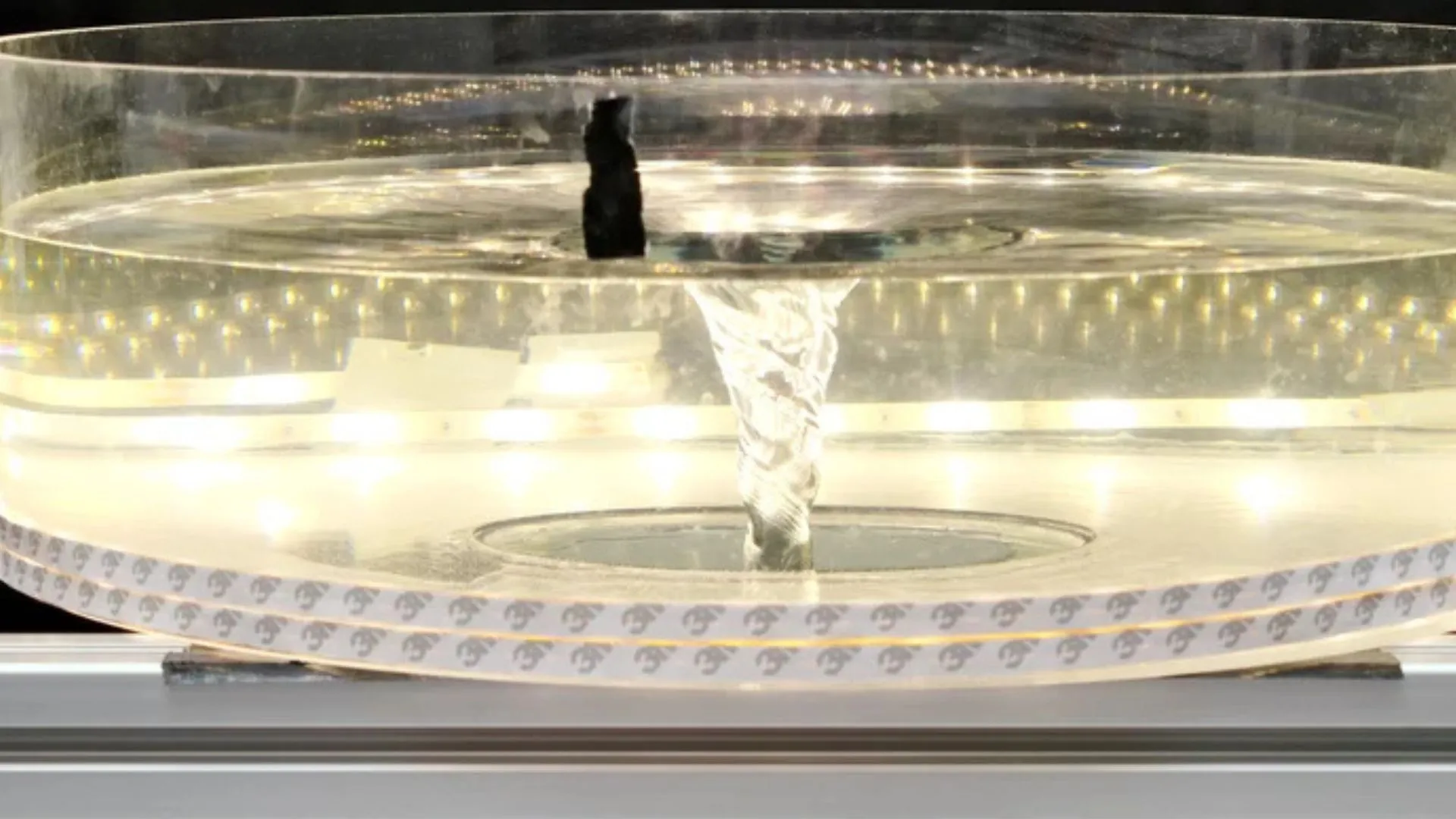
Researchers have developed a straightforward laboratory model that utilizes a water tornado to simulate the dynamics of gas and dust within planet-forming discs. This initiative stems from the long-standing challenge of studying the swirling clouds of gas and dust surrounding young stars, which serve as the nurseries for planet formation.
Observing these vast cosmic regions directly poses significant difficulties. In response, the University of Greifswald and the Max Planck Institute for Astronomy in Germany created a powerful yet simple model. They designed an inexpensive and easy-to-construct prototype experimental setup that employs a water tornado to replicate the flow properties observed in accretion discs.
Accretion discs orbit various celestial bodies, from massive black holes to newly formed stars. These colossal structures consist of gas and dust that spiral inward, gradually feeding the central object. For young stars, this combination of gas and microscopic solid particles—referred to as dust—provides the raw materials necessary for planet formation. Microscopic dust particles collide and merge, eventually forming objects thousands of kilometers across, serving as the building blocks of planets. The interactions within these discs represent a complex balance between orderly orbits and chaotic vortices, occurring on scales that are challenging to comprehend.
Historically, understanding these processes depended on complex computer simulations, which often struggled to incorporate all relevant scales and could yield misleading results. The introduction of the water tornado model addresses these limitations. Previous models could only simulate narrow, ring-shaped areas, while this innovative approach allows for a broader range of distances from the center.
“The motions and flows closely resemble those observed in planet-forming discs and planetary systems,” explained Stefan Knauer from the University of Greifswald. Notably, fundamental principles such as Kepler’s laws—the established rules governing planetary orbits—are applicable within this water tornado model.
The construction of this experimental setup is surprisingly low-tech. It consists of two transparent acrylic cylinders, with one being wider than the other. At the base of the smaller cylinder, a central outlet along with two nozzles pumps water in opposite directions, creating a powerful vortex that mimics a gravitational field. This accurate representation of a star’s gravitational pull within a protoplanetary disc is essential for the experiment.
To study the flow dynamics, researchers introduced small polypropylene beads into the vortex, allowing them to float just below the surface. A high-speed camera captures their movements, while a computer algorithm maps out their trajectories. Although not all orbits are perfectly elliptical as per Kepler’s ideal, the model effectively demonstrated other key principles: particles accelerate as they approach the center, and there is a distinct correlation between their orbital period and size.
This prototype has shown promising initial results. Mario Flock, a researcher focusing on planet-forming discs through computational methods, expressed optimism: “I am confident that, with a few modifications, we can refine the water tornado model and bring it closer to scientific application.” The findings indicate that sufficiently small particles introduced into the laboratory vortex should mimic the behavior of dust grains in real cosmic environments.
This affordable and adaptable experimental setup opens new avenues for studying the intricate interactions between dust and gas, potentially shedding light on the mysteries of planet formation and the origins of life itself.
